Sunday, January 15, 2012

Speak; Your Servant is Listening: Sermon, January 15, 2012

Now the boy Samuel was serving the LORD under Eli. The LORD ’s word was rare at that time, and visions weren’t widely known. One day Eli, whose eyes had grown so weak he was unable to see, was lying down in his room. God’s lamp hadn’t gone out yet, and Samuel was lying down in the LORD's temple, where God’s chest was.

The LORD called to Samuel. “I’m here,” he said.

Samuel hurried to Eli and said, “I’m here. You called me?”

“I didn’t call you,” Eli replied. “Go lie down.” So he did.

Again the LORD called Samuel, so Samuel got up, went to Eli, and said, “I’m here. You called me?” “I didn’t call, my son,” Eli replied. “Go and lie down.”

(Now Samuel didn’t yet know the LORD, and the LORD’s word hadn’t yet been revealed to him.)

A third time the LORD called Samuel. He got up, went to Eli, and said, “I’m here. You called me?” Then Eli realized that it was the LORD who was calling the boy. So Eli said to Samuel, “Go and lie down. If he calls you, say ‘Speak, LORD. Your servant is listening.’” So Samuel went and lay down where he’d been.

Then the LORD came and stood there, calling just as before, “Samuel, Samuel!”

Samuel said, “Speak. Your servant is listening.”

- 1 Samuel 3:1-10, Common English Bible

The next day Jesus wanted to go into Galilee, and he found Philip. Jesus said to him, “Follow me.” Philip was from Bethsaida, the hometown of Andrew and Peter.

Philip found Nathanael and said to him, “We have found the one Moses wrote about in the Law and the Prophets: Jesus, Joseph’s son, from Nazareth.”

Nathanael responded, “Can anything from Nazareth be good?”

Philip said, “Come and see.”

Jesus saw Nathanael coming toward him and said about him, “Here is a genuine Israelite in whom there is no deceit.”

Nathanael asked him, “How do you know me?”

Jesus answered, “Before Philip called you, I saw you under the fig tree.”

Nathanael replied, “Rabbi, you are God’s Son. You are the king of Israel.”

Jesus answered, “Do you believe because I told you that I saw you under the fig tree? You will see greater things than these! I assure you that you will see heaven open and God’s angels going up to heaven and down to earth on the Human One."

- John 1:43-51, Common English Bible

Giving all glory and honour to God.

We have two stories today about call: God calls Samuel, and Jesus calls Philip and Nathanael. My childhood Bible had a coloured picture of Samuel looking up and saying, “Speak, Lord, your servant is listening.”

Today I’m thinking of a little illustration from Søren Kierkegaard. He lived in Denmark about 170 years ago, and is one of my favourite thinkers. Actually, at first I thought he was the Danish guy who wrote the story about the ugly duckling who turns into a swan, but that turned out to be Hans Christian Andersen.

Kierkegaard had some great little illustrations for what he was saying about God, and Christ, and the Christian life. I thought of one of them when we were at Upper Canada Village for Alight at Night. We rode on the big wagon, but you could also book a carriage with just one horse and driver, with lanterns on each side. It looked very nice on the dark village streets. Kierkegaard lived when people did travel like this, and he used this in one of his word pictures, one very appropriate for Epiphany, this season of light.

When the prosperous man on a dark but star-lit night drives comfortably in his carriage and has the lanterns lighted, then he is safe, he fears no difficulty, he carries his light with him, and it is not dark close around him. But because he has the lanterns lighted, and has a strong light close to him, precisely for this reason he cannot see the stars, for his lights obscure the stars, which the poor farmer driving without lights can see gloriously in the dark but starry night. So many people are among the deceived ones; either, occupied with the necessities of life, they are too busy to see the view of the stars, or in their prosperity, it is as if they have lanterns lighted, and close around them everything is so satisfactory, so pleasant, so comfortable – but the view is lacking, and they cannot see the stars.
This story comes from Kierkegaard's The Gospel of Suffering, quoted in Vernand Eller, The Simple Life, Grand Rapids MI: Wm. B. Eerdmans, 1973.

We can be like the rich man in that antique carriage, comfortable, safe with the lanterns lit. And then we miss the stars: the stars God made, these balls of gas thousands and millions of light years away – I was reading the other day that our own galaxy, the Milky Way, has over 100 billion stars. We can see only a few of them. And we can miss them if we don’t look, or we don’t go outside, or our view is limited by lights around us. To use another example, if you live east of Ingleside and all the lights are turned on where they’re building that new solar farm, you miss the stars because the whole sky is lit up.

Just as we can miss the stars in the night sky with our eyes, we can miss God’s call with our senses and our minds. Samuel hears God calling to him, calling over and over, but assumes it’s Eli. Philip goes to his friend Nathanael to tell him that Jesus has called him and told him to follow, and he says to Nathanael, “We have found the one written about in the Bible, Jesus son of Joseph from Nazareth.” And Nathanael is a typical young guy who just snorts and blows Philip off, dismissing him by saying, “Can anything good come out of Nazareth?” Nathanael is from a different town, and he rejects anyone or anything that is from anywhere else. It’s like a Montreal Canadiens fan dissing a new player for the Toronto Maple Leafs.

God called Samuel to be a prophet. Jesus called Philip and Nathanael to be his followers, to travel with him and learn his message and bring it to the world. We talk about call in these Bible stories, and when we call a minister. But we can’t hem in God’s call to a few people long ago and ministers today.

God calls all of us. Our Psalm today, Psalm 139, says that God has a destiny for us, known to God since before we were created. God may be calling us to a new ministry here in our congregation or our community or the wider church, or a new or renewed focus in what we’re already doing. God may be calling us to leadership in a church committee, in a role where we touch the lives of many people, or God may be calling us to make a difference in one person’s life. God may be calling us to use our talents in a role we are good at and experienced in, or God may be calling us to discover a gift we did not know we had. God may be calling us to step back and spend less time acting and more time reflecting. God may be calling us over and over, to different things or the same thing. Sometimes God calls in one sudden, dramatic moment, sometimes God’s Spirit whispers to us and pushes us over a long period of time.

Just like Samuel and Philip and Nathanael, we have to figure out God’s call to us. And we can’t always predict what that call will mean for our lives. Philip couldn’t have predicted on the day he met Jesus that in a few years he would be traveling and baptizing. We just have to follow and let God use us, as Philip and Nathanael and Samuel did. That God calls us can be a source of strength, and it can be scary.

Right now, we have to discern God’s call to us, as individuals and as a congregation, to what we were meant to do and be. In November we voted on whether to engage in conversations with other congregations on possible cooperation in a cluster arrangement sharing ministries together, and the Holy Spirit moved in here, and we believed that we were called to say yes to dialogue. In some other congregations people felt that the Spirit was prodding them to vote no, and that’s how they felt called. And then it was the season of Advent, and then Christmas, and then the new year. And now we are called to decide on how to move, and how soon, and who to talk with.

Some congregations have come back and said, we’re waiting for the Presbytery to tell us what to do, but this process can’t work that way. The Presbytery and ministers are just resources, helping to facilitate conversations. If this comes from the top down, instead of from the grassroots, it won’t work because it won’t be of the people. It’s up to you to settle on the way to act on your vote, how to respond to invitations to talk, how to approach others, who to ask. It’s a bit like dating; you can’t rely on your best friend to ask girls or guys out for you. Well, you might, but it’s not a recipe for success.

So it’s up to you. And as I’m not the leader in this process, I don’t know if any overtures have been received, or any talks have taken place already. A response to God’s call may be already going on.

As always, we may be tempted to ignore the call. We may be like the prosperous man Kierkegaard talked about, in his carriage with the warm lantern light, comfortable and safe, but unable to see the stars. We block them out. God may be calling our name, just as God called "Samuel, Samuel," and we can’t decide that it is God’s call. God has a purpose for us, as there was a purpose for Nathanael, but just like him who didn’t think anything good could come from Nazareth, we’re too caught up in our preconceived ideas and prejudices to acknowledge it. And even though we voted yes to talking with other congregations, we may be thinking now, well, that was then, this is now, things still seem fine, we’re good as we are, we’re going to postpone this dialogue about new ways to be church, new ways to serve God and our neighbours, new ways to live out God’s call.

We need to be less like the rich man, happy and secure but unable to see beyond a little distance around him, and more like the poor farmer who may be less at ease and taking more of a risk, yet can see the entire night sky. We need to get that big picture so we can recognize and respond to God’s call, whatever that call may be, however many times it comes, whichever way it comes, in the surprising ways God works. And as we hear, as we see, as we discern, God who called us remains with us in the Spirit, guiding, strengthening, comforting, loving. Speak, God, for your servants are listening.

Thursday, January 05, 2012

The Exile on Main Street Express

Tuesday, December 27, 2011

A couple of requests...

I don't usually make these requests of readers of my blog, but perhaps these may strike a chord with you:
I'm participating in the Common English Bible blog tour. If you like the Facebook page you will be able to print beautiful calligraphy Bible verses.
I met Timothy Kurek at OP11 in Nashville in September. His first book is due to be released in September 2012, and he is asking for folks to like his Facebook page - he's hoping to get a thousand "likes" by the time he is done his second draft.

Friday, December 23, 2011

Quickly to Bethlehem: Sermon, December 24, 2011

Nearby shepherds were living in the fields, guarding their sheep at night. The Lord’s angel stood before them, the Lord’s glory shone around them, and they were terrified.

The angel said, “Don’t be afraid! Look! I bring good news to you — wonderful, joyous news for all people. Your saviour is born today in David’s city. He is Christ the Lord. This is a sign for you: you will find a newborn baby wrapped snugly and lying in a manger.” Suddenly a great assembly of the heavenly forces was with the angel praising God. They said, "Glory to God in heaven, and on earth peace among those whom he favours.”

When the angels returned to heaven, the shepherds said to each other, “Let’s go right now to Bethlehem and see what’s happened. Let’s confirm what the Lord has revealed to us.” They went quickly and found Mary and Joseph, and the baby lying in the manger. When they saw this, they reported what they had been told about this child. Everyone who heard it was amazed at what the shepherds told them. Mary committed these things to memory and considered them carefully. The shepherds returned home, glorifying and praising God for all they had heard and seen. Everything happened just as they had been told.

Luke 2:8-20, Common English Bible

Giving all glory and honour to God.

Christmas is a time for stories. We tell the Christmas story, and other stories that build on it, about the animals and the shepherds and the littlest angel and the little drummer boy, and other stories about Frosty and Rudolph. And we tell stories about our families and the Christmases of past years, sometimes happy stories, sometimes sad, sometimes funny. My mother used to tell about a Christmas dinner at her aunt Nellie’s, and an argument broke out, and Nellie, who had had a few drinks, got angry and grabbed the turkey in the oven with her bare hands and slammed it onto the table. That was probably a lot funnier later than it was at the time, when it was probably pretty scary.

At Christmastime I think about a relative of mine, Arch Hatfield, who had been a lumberjack in Nova Scotia and became a Baptist minister. He was in the Primitive Baptist church. It’s since changed its name, as I guess no one wants to be primitive anymore. And my father’s family had several stories about him, when he was ministering in Carleton County in New Brunswick. He was called the Shepherd of Carleton. I may have told you before about one Sunday in the 1930s. Arch had come to preach the evening service in the church, and as it was the Depression Grampy had no money to put in the collection plate, so when Arch came he and Grammy gave him a meal, fed his horse, and sent him away with a bag of grain, some eggs, or maybe a roast. That was how ministers were paid then. Now we have direct deposit.

This one time Arch was with Grampy and my Dad and uncle in the barn. It was getting dark and the turkeys were getting in position to roost on the beams. One young gobbler missed its footing and crashed to the barn floor, lying there stunned. In an instant Grampy had his pocket knife out – all men carried knives then – beheaded the turkey, rubbed the feathers off, and dressed it on the spot. He handed the bird to Arch and said, “Here’s your Christmas dinner!” Arch was speechless. He couldn’t believe what he had just seen, and went away talking about how God always provides. Later it came out that he had been very anxious about Christmas dinner for his family, as money was scarce and no one had given them a turkey or ham. In my family this was the story of the Christmas turkey miracle.

Tonight I’m thinking of another of our family stories. Once, during the 1950s so Arch had a car instead of a horse, Arch was driving to a service in the country. I think it was Christmas Day, and it was a cold and snowy Christmas. The car got stuck on a lonely stretch of road. Arch decided to walk the rest of the way to church, about six miles. I should mention that he would then have been over 70 years old. So he headed through the driving snow and bitter cold. He got there, but was so late that the congregation had gone home. Yet, as I heard the story, folks came back and got the stove going and people came in to hear the Christmas message and sing the carols about Jesus being born.

This makes me think of our Christmas story, the first Christmas story. The angels don’t bring the news of Christmas to the ruler and his court, or the rich people, or the religious authorities, or even to city dwellers. They announce it to shepherds, at work with their flocks in the fields - just simple, no-nonsense, plain-spoken country people, so poor and ordinary that other people back then looked down on them. They are chosen to be the first to know what has happened. And remember what happens in the story when the angels disappear. The shepherds say to each other, “Let’s go right now to Bethlehem and see what’s happened. Let’s confirm what God has revealed to us.” Luke wrote this story down, and he writes that they went quickly. Luke wrote in Greek, and the word here means the shepherds hurried, they raced, to get to Bethlehem. Hearing about these shepherds, I can only think of Arch Hatfield, the Shepherd of Carleton, another down-to-earth, simple country person, in his 70s, slogging through the snowdrifts and struggling against the wind and blowing snow, trying to get to a Christmas church service as fast as he could, hurrying as if to Bethlehem.

What would draw these shepherds, 2000 years ago, 60 years ago, to rush like this? What is it about this night that would cause anyone to risk rushing across rocky, pitch-dark hills in Palestine or up a windswept, snow-covered road in rural New Brunswick?

What did we just sing? The second verse of Angels From the Realms of Glory – shepherds in the field abiding, watching o’er your flocks by night, God with us is now residing, yonder shines the infant light. God with us is now residing. The child born to Mary in Bethlehem is God with us. Emmanuel. The Christmas story we read is from the good news according to Luke. John doesn’t have a Christmas story, but his gospel starts by telling us, the Word became flesh and dwelt among us. We say this in the United Church’s new creed, God has come in Jesus, the Word made flesh. The Christ, the anointed one of the ancient prophecies, is God’s Word, through whom and for whom all things were created. And, somehow, mysteriously, the divine Word of God becomes human and is born as we are, and is named Jesus, which means Saviour.

God comes to be with us in a tiny, vulnerable baby. We may sing, little Lord Jesus no crying he makes, and holy infant so tender and mild, but we know that if he really is human the baby Jesus cried and spit up and made as much of a mess as we did. And he who is somehow divine and human, he who is God come to be with us, is not born in the imperial capital or even in a city, but in a little town, a remote place on the fringe of the empire, in the sticks really, and not in a palace or a temple or a mansion or even a house. My mother used to say, were you born in a barn, but Christ the Lord IS born in a barn, born amid animal smells and hay, and laid in a manger, a feeding trough.

Now, if that is the whole story, that alone would be awesome. And often we want that to be the whole story. If you saw the movie Talladega Nights, you remember that NASCAR driver Ricky Bobby likes to pray to baby Jesus. He tells his wife, "look, I like Christmas Jesus best. When you say grace, you can say it to grownup Jesus, or teenage Jesus, or bearded Jesus, or whoever you want." So he prays, "dear eight pound six ounce newborn baby Jesus, don’t even know a word yet, just a little infant and so cuddly, but still omnipotent."

Well, we can be like Ricky Bobby sometimes, staying with the Christmas Jesus, just as parents look at their sleeping babies and whisper, I wish they could just stay like this forever. Other times parents wish their babies would grow up already. And our babies do get bigger, and so does baby Jesus. He does grow up, to teach us, to challenge us, to confront us, to be with and love the people excluded from polite society, to show us what God is like, how much God loves us and accepts us, and how God wants to change us so that we are more like Jesus, more like God. Jesus came so we can be more truly human, and thus more godlike. And Jesus doesn’t wave his hand and solve the world’s problems, but is the king who comes to serve, and to suffer. We will follow the story from Christmas to Good Friday and Easter, when Jesus will die and rise again from death, to free us from death.

You know, there’s a slogan this time of year, Jesus is the reason for the season, and that’s true, although I think Jesus would be dismayed that his followers get so agitated about whether or not a store wishes customers Merry Christmas.

Jesus is the reason for the season. But not the only reason. There’s more. One of the readings from the Bible for Christmas Day is from the letter to Titus, and it says, when God our saviour’s kindness and love appeared, he saved us because of God’s mercy, not because of righteous things we had done, through the Holy Spirit which God poured out on us generously through Jesus Christ our saviour. Saved US. Poured out on US. Brothers and sisters, the whole story of salvation, Christmas, Good Friday, Easter, is all for us. WE are the reason for the season. God chose to take human form, to be the eight pound six ounce newborn baby Jesus of Christmas, for us, so that WE can be the body of Christ in the world, so that WE can help to bring God’s realm of love and justice and peace, so that WE can be transformed, so that WE can have more abundant life now, and so that WE will have eternal life as death will not hold us.

Now that IS awesome. That is good news of great joy for all people. That’s why Arch Hatfield trudged through the snow and endured the cold to worship at Christmas. That’s why folks then came back and filled the church and sang and prayed on Christmas Day. That’s why we’re here.

In our story the shepherds return home, glorifying and praising God for all they had heard and seen. And we will go out with the joyous songs of Christmas on our lips and the wonderful news of Christmas in our hearts, that God has come to be with us in Jesus Christ, praising God that Jesus is born for us. Born that we no more may die, born to raise us from the earth, born to give us second birth. Hark the herald angels sing, glory to the newborn King.

Wednesday, December 21, 2011

Christmas Eve Call to Worship

Yesterday I wrote the services for Christmas Eve and New Year's Day. One advantage or disadvantage of our United Church of Canada Presbyterian/Methodist/Congregationalist/Evangelical United Brethren tradition is that we don't have a common prayer book or missal, and our worship is customized for each congregation or pastoral charge.

This doesn't mean that everything is written from scratch; I often adapt worship materials from other denominations shared through LiturgyLink or TextWeek, or supplied by our own worship leaders to Gathering, the United Church worship resource. I hadn't been able to find a suitable Call to Worship to begin the Christmas Eve service, so I wrote one from the prophecies of the Christ, found in Isaiah, and the Christmas story from Luke's Gospel, taken from the Common English Bible.

The convention in our service bulletins is that the words spoken by the worship leader are printed in the regular font; the congregation says the words in bold.

An angel comes to shepherds in the country, and tells them:
Your Saviour is born today in David’s city. He is Christ the Lord.
And a whole assembly of angels proclaims:
Glory to God in heaven, and on earth peace.
For the ancient prophecies have come true,
The people walking in darkness have seen a great light. On those living in a pitch-dark land, light has dawned.
A child is born to us, a son is given to us.
He will be named Wonderful Counselor, Mighty God, Eternal Father, Prince of Peace.
God has given us a sign:
A young woman will give birth to a son, and he will be called Emmanuel, God with us.
Like the shepherds,
Let’s go right now to Bethlehem and see what’s happened.
Let us worship God who comes among us tonight as a tiny baby.

Saturday, December 10, 2011

Looking into small group resources: MissioLife

I was sent a copy of the MissioLife resource for small church groups. I have been trying to find good group materials - I'm convinced that active small groups are important for the spiritual life of congregations. So far we have had a Christian meditation group, and a group study of the Canadian Foodgrains Bank Seven Days to Tend the Earth booklet on faith and food. In Lent we will be studying the United Church of Canada's doctrinal statements, prior to our Sesssions voting on our statements of faith. Now I'm looking for a group resource that does what MissioLife claims to do: "guide adults, youth and children on a pilgrimage through Scripture from understanding to participation in the mission of God."

The MissioLife module I received came in an attractive translucent plastic envelope, with a DVD of videos and lesson samples, and an explanatory booklet. This arrived a few days ago, but as usual in the season of Advent it's taken me a while to get to it, and I'm only just starting. But the introduction in the booklet grabbed me:

...many lifelong Christians have discovered that though they can recite well-known passages of Scripture from memory, they still do not always see how these passages fit into the story of God. For many Christians, biblical literacy - while necessary and important - has not translated into a solid understanding of God's redemptive plan as one contiguous stretch throughout history and into the future...Many of us fail to see that the story of Scripture is our story.

This echoes something I have said before, and often, about believers needing to see the history of salvation in the broad sweep of Scripture, and to understand how we are players in the story as God's plan continues to unfold.

MissioLife claims to "provide a theological framework for spiritual formation tailored to all age-groups' unique needs and cognitive abilities while allowing for the unpredictable and unexpected movement of the Holy Spirit to transform lives." I hope it does, and I'll be delving further into it.

Tuesday, December 06, 2011

Experimenting With Nomad

I'm a beta tester for Nomad - no, not the space probe from a Star Trek episode. It's a widget from paper.li, allowing a customized digital newspaper to be embedded in a blog. My Exile on Main Street Express is built from links in my Twitter feed. You'll see the results daily - or when I get to posting!

Friday, December 02, 2011

Holy and Godly Lives: Sermon, December 4, 2011

2 Peter 3:8-15a
From the Common English Bible

Don’t let it escape your notice, dear friends, that with the Lord a single day is like a thousand years and a thousand years are like a single day. The Lord isn’t slow to keep his promise, as some think of slowness, but he is patient toward you, not wanting anyone to perish but all to change their hearts and lives. But the day of the Lord will come like a thief. On that day the heavens will pass away with a dreadful noise, the elements will be consumed by fire, and the earth and all the works done on it will be exposed.

Since everything will be destroyed in this way, what sort of people ought you to be? You must live holy and godly lives, waiting for and hastening the coming day of God. Because of that day, the heavens will be destroyed by fire and the elements will melt away in the flames. But according to his promise we are waiting for a new heaven and a new earth, where righteousness is at home.

Therefore, dear friends, while you are waiting for these things to happen, make every effort to be found by him in peace—pure and faultless. Consider the patience of our Lord to be salvation.

Mark 1:1-8
From the Common English Bible

The beginning of the good news about Jesus Christ, God’s Son, happened just as it was written about in the prophecy of Isaiah:

Look, I am sending my messenger before you. He will prepare your way, a voice shouting in the wilderness: “Prepare the way for the Lord; make his paths straight.”
John was in the wilderness calling for people to be baptized to show that they were changing their hearts and lives and wanted God to forgive their sins. Everyone in Judea and all the people of Jerusalem went out to the Jordan River and were being baptized by John as they confessed their sins. John wore clothes made of camel’s hair, with a leather belt around his waist. He ate locusts and wild honey. He announced, “One stronger than I am is coming after me. I’m not even worthy to bend over and loosen the strap of his sandals. I baptize you with water, but he will baptize you with the Holy Spirit.”

Giving all glory and honour to God.

We talked last week about how we expect to look back in this Advent season at the first Christmas, and instead our readings are telling us to look forward to the end of time. Well, this week our Scripture does look back, but not to the Christmas story. Instead we get the story of John the Baptist, who appears when Jesus is an adult, as the prophecy comes true that a voice will cry out in the wilderness, prepare God’s way. And we get more bizarre and upsetting imagery: last week Jesus spoke about the sun and moon ceasing to shine, and the stars falling from the sky; today in our reading from the Second Letter of Peter we have more about this day of the Lord, the end of this world, coming by surprise as the heavens are destroyed and the elements melt away. This part of the Bible was written in Greek, and the Greek word for elements could mean earth, air, fire, and water, or the sun, moon, and stars, or even atomic particles – the point is, all will disintegrate and burn up. On this Advent Sunday of peace, this doesn’t seem like that peaceful a picture.

We know from science that all this will come true – in about 5 billion years our sun will become many times brighter, causing the oceans to evaporate and eventually the earth’s surface to become molten rock. In another billion years or so our planet’s orbit will decay and the earth will be destroyed as it enters the sun’s atmosphere. So the elements will indeed be consumed by fire. Although this could happen earlier if the Andromeda Galaxy collides with our galaxy, the Milky Way, 3 billion years from now and the earth’s orbit changes. All this sounds like the plot of a Star Trek episode. I remember watching Star Trek: The Next Generation, and Captain Picard is on a planet where increased radiation from its sun will eventually cause all life to become extinct.

I doubt that I will be around in 3 or 5 billion years, but that’s not so long in geologic time – I was in Ottawa this week and stopped by a booth in a mall, and they had fossils and rocks on display and I saw insects preserved in amber that is 2 million years old, and fossilized ferns and fish and dinosaur bones that are much older.

And John the Baptist gets in on all this frightening language too. We read from Mark’s Gospel, which is the shortest story about John, and he doesn’t have too much to say. In Luke’s version, John calls the crowds children of snakes, translated in some Bibles as brood of vipers, and goes on about the people listening to him being like trees that do not produce good fruit and will be chopped down and tossed into the fire.

All this just makes us uncomfortable. We’re not featuring these verses on our Christmas cards, or sending cards that say “from our brood of vipers to yours.” I said last week that all this scary stuff about the world’s end is really symbolic. The destruction of the heavens and even atoms is a symbol of how total the transformation is when God’s vision is fulfilled. I think the key part of this reading is what it says next, the earth and all the works done on it will be exposed, meaning human achievements and actions will be held up for divine judgment.

All this apocalyptic language is written from a certain perspective, that of people on the bottom of the heap, people with so little that they have nothing to lose, people who have given up hope that the systems of this world will work for them. These symbols of stars falling and elements burning up, the Bible’s language about the last shall be first and the humble exalted and the poor raised up from the garbage heap and all things will be made new – these express the only hope oppressed people have, that God will flip over the existing powers that keep them down, God will expose all human works to judgment.

Look at the stories we hear during Advent and Christmas. God doesn’t come to or with the powerful people at the centre of empire. God surprises everyone by coming where people don’t expect, on the margins, with the marginalized. Isaiah’s prophecy comes true in a weird guy shouting in a desert on the fringe of the empire, a guy eating locusts and wild honey. John the Baptist is the guy we avoid when we’re walking in the city. Joseph and Mary are forced to migrate by an official directive, to Bethlehem to be taxed to pay for the empire – which sounds pretty familiar, bureaucracy and taxes and controversy over a census, and families forced to move by a corporate decision made far away. And then later in the story they are refugees, barely escaping state violence that sounds like Syria today. The news that God has come among us is told to ordinary shepherds, country folk, who are at work, not participating in a worship service. God comes to Mary, a teenage, uneducated girl in a society in which women were powerless, when pregnancy before marriage was a dangerous state to be in, yet in the story she sings that God will pull the powerful down from their thrones and lift up the lowly, God will fill the hungry with good things and send the rich away empty-handed. Mary is not the timid figure of our nativity sets. She is preaching revolution. And God comes to humanity, not in the capital city that is the centre of the known world, not even in one of the great cities of the empire, but in an obscure, one-horse town on the border, not to a palace or temple or mansion but to a stable with its smells and dirt, not as a mighty emperor or wealthy merchant or respected priest – God is born as a baby, tiny, vulnerable, completely dependent on humans.

So this story should be good news for us, country people who know about paying taxes, being pushed around by bureaucracy, decisions made far away which change our lives as a plant is closed and people are thrown out of work or families forced to move. But the story has been taken over by the powerful, sanitizing it and making it less uncomfortable, glossing over the poverty and violence and dirt, making all the characters well-dressed and clean. Well, except for John the Baptist – he’s still a wild man. We lit a candle for angels today, and now serene angels in lovely robes are Christmas decorations, as we forget that when angels appear in the Christmas story their first words have to be, ‘Don’t be afraid,’ because a message from God is so terrifying. And all the bizarre Advent stuff about the end of time and completion of God’s rule gets left out.

Yet we still know that there is something jarring here. We know that as we’re surrounded by lights and buying and nostalgic Christmas specials, somehow the Bible story pulls at us. We hear about World AIDS Day, last Thursday, how HIV has infected 34 million people worldwide and 1.8 million people will die this year of AIDS. We know that something is wrong. We hear about the National Day of Remembrance and Action on Violence Against Women, this coming Tuesday, and we remember 14 women killed in Montreal in 1989, and all the victims of gender violence. We know that something is wrong. Today is White Gift Sunday, and many families in this county rely on food banks to eat. We know that something is wrong. And we have to wonder, what if all our works on earth are exposed? How will what we have done, what we do, be judged?

The writer of Second Peter, after describing all this cosmic drama at the end and the final judgment of human actions, asks what we ask, “Then what sort of people ought you to be? You must live holy and godly lives, waiting for and hastening the coming day of God.”

Holy and godly lives. A holy and godly life means trying to follow Jesus in his way, and so, seeking to transform both ourselves and our world. A holy and godly life means prayer, devotions, moral living, and labour for the common good of all. People often talk as if personal spirituality and work for justice and peace are completely separate, but we can’t disconnect them. Second Peter says, while you are waiting for these things to happen, make every effort to be found in peace – peace with ourselves, peace with each other, seeking peace in our world.

The planet being destroyed and elements melting are symbols of the transformation God brings. Our White Gifts are a symbol too – a symbol of our own path to transformation, as our faith changes us to dedicate ourselves to serving and loving others, particularly our neighbours who are in need.

We are to bring food to food banks and women’s shelters, but also to ask why systems perpetuate hunger and poverty and violence. We are to recognize how the characters in the Christmas story were trapped in systems that kept them poor and powerless, yet today the systems that benefit us hold us just as captive. We live a holy and godly life by waiting, praying for the completion of God’s rule of peace and love and justice – not waiting passively, but waiting actively as John the Baptist did, working within the structures of which we’re a part while waiting for these systems to end, looking with the Spirit’s help to recognize where God is coming among us today in the margins, in the cracks, to identify the prophets and angels that bring God’s message to us now and to heed their words, each of us being in our own way a voice shouting in the wilderness.

You know, there is a slogan this time of year, keep Christ in Christmas. Yes, and we are to keep Christ in our lives, Christ who tells us to love our neighbour, Christ who tells us blessed are the peacemakers, Christ who tells us that in him we can overcome the world, Christ who is coming to make all things new. Come, Lord Jesus. Amen.

Tuesday, November 29, 2011

Mountains flattened, elements melted, and a giveaway

Loving my new Common English Bible - I've been using the New Testament for a year or so for the lectionary readings in Sunday worship, but now this translation is out with both testaments and I use it for both personal and public reading.

I'm preparing for Sunday, December 4, and am looking at the lectionary texts in the CEB.

The Call to Worship at the beginning of Sunday's service will come from Isaiah 40:1-11, specifically verses 3 to 5:

A voice is crying out, 'Clear the Lord's way in the desert! Make a level highway in the wilderness for our God! Every valley will be raised up, and every mountain and hill will be flattened. Uneven ground will become level, and rough terrain a valley plain. The Lord's glory will appear, and all humanity will see it together; The Lord's mouth has commanded it.

I will be preaching on 2 Peter 3:10-13:

But the day of the Lord will come like a thief. On that day the heavens will pass away with a dreadful noise, the elements will be consumed by fire, and the earth and all the works done on it will be exposed.
Since everything will be destroyed in this way, what sort of people ought you to be? You must live holy and godly lives, waiting for and hastening the coming day of God. Because of that day, the heavens will be destroyed by fire and the elements will melt away in the flames. But according to his promise we are waiting for a new heaven and a new earth, where righteousness is at home.

I think the CEB translators have made some good choices here in dealing with the Greek text and English equivalents: compare "the earth and all the works done on it will be exposed" with the less clear "the earth and everything that is done on it will be disclosed" in the New Revised Standard Version. I prefer the CEB's plain "since everything will be destroyed in this way" to the NRSV's murky "since all these things are to be dissolved in this way." The NRSV's verb "dissolved" may be closer to the original Greek luomenon, which means "loosened," but the CEB and New International Version translation of "destroyed" better expresses the ancient writer's meaning.

As a participant in the Common English Bible Blog Tour, I am able to give away copies of this new translation - a Bible which I am using every day. I'll be selecting someone who comments on this, or any, blog post here at Daniel in the Lions' Den to receive a CEB, for your Advent journey.

Tuesday, November 22, 2011

Tear open the heavens...

I've been cramming what is usually a week of preparation for Advent services into one day, for various reasons, the chief one being Advent seems to have sneaked up on me! I'm now thinking about the Scriptures we're reading this coming Sunday, November 27, and what to say about them. I cobbled together a Call to Worship for our Sunday liturgy, based on the lectionary passages for the First Sunday of Advent: Isaiah 64:1-9 and Mark 13:24-37.
O that God would rip open the heavens and come down, and make the mountains shudder.
But isn’t this season about tinsel decorations and Santa?
The sun will become dark, the moon won’t give its light, the stars will fall from the sky, and the planets will be shaken.
But isn’t this season about lights twinkling in the streets?
Then you will see the Christ coming in the clouds, with great power and splendour.
That sounds more like it – the hope we’re looking for, the promise of something better to come. We can’t wait!
But now we must wait. Keep watch! Stay alert! You don’t know when the time is coming.
Come, Lord Jesus!
Come, Lord Jesus. We wait for this hope to arrive, we long for Jesus to return, we look for the signs of God coming among us. Let us wait and worship together.

In writing, I picked up on Isaiah 64:1-2: "If only you would tear open the heavens and come down! Mountains would quake before you like fire igniting brushwood or making water boil" (Common English Bible) - but went with the language used by The Message translation, "rip open" and "shudder" - and Mark 13:24-26: "In those days, after the suffering of that time, the sun will become dark, and the moon won't give its light. The stars will fall from the sky, and the planets and other heavenly bodies will be shaken. Then they will see the Human One coming in the clouds with great power and splendour"(Common English Bible). I kept much of the CEB wording for the Mark passage. I was trying to incorporate the eschatology in the readings for Advent 1, the waiting that is so countercultural for us in Advent when Christmas seems to start the day after Hallowe'en, and the consumerist trappings of the secular Christmas.

A version of this Call to Worship has now been posted by LiturgyLink, so it's available for other time-pressed pastors this coming Sunday!

Sunday, November 20, 2011

For the Bible Tells Me So

Since childhood you have known the holy scriptures that help you to be wise in a way that leads to salvation through faith that is in Christ Jesus. Every scripture is inspired by God and is useful for teaching, for showing mistakes, for correcting, and for training character, so that the person who belongs to God can be equipped to do everything that is good.
2 Timothy 3:15-17, Common English Bible
The Bible is the story for us of God's revelation to humanity, in the story of Israel and in Jesus Christ. As Marcus Borg says in The Heart of Christianity, to be a Christian is to be centred in the God of the Bible.

I believe what this early Christian document, the Second Letter to Timothy, says: Scripture is inspired by God. However, this does not mean, for me, that the Bible is infallible and inerrant. Much of what ancient communities wrote was inspired, but is not meant to be historically factual; this does not mean it is false, as it is true in the sense of metaphor, and witnesses to truths about God.

There are commentators who state that if any part of the Bible is held not to be literally true, then the entire edifice of faith collapses. I think this does a disservice to both the Bible and Christianity, and devalues metaphorical language. It also does not serve the Bible well to state that one translation only is valid. We do not have one definitive version of the original texts - the Common English Bible lists five different manuscripts of the Greek Septuagint for the books of Samuel alone. The 1611 Authorized Version, called the King James Bible, is now celebrating the 400th anniversary of its beautiful language which has made such an impact on English literature and speech. Yet we now have better Hebrew and Greek manuscripts than were available to the King James translators. All translators have to make choices in rendering ancient words and their underlying concepts into today's speech.

In the season of Advent we will be reading from two translations in worship at Ingleside and Newington: the King James, to end the 400th anniversary year, and the new Common English Bible. This should provide some great, and thought-provoking, contrasts between a venerable translation and a fresh version. I think we can learn from how the translators have rendered, for instance, the Isaiah 64 reading for next Sunday:

But we are all as an unclean thing, and all our righteousnesses are as filthy rags.
Isaiah 64:6a, King James Bible

We have all become like the unclean; all our righteous deeds are like a menstrual rag.
Isaiah 64:6a, Common English Bible

What do these words tell us about ourselves? About the translators? About the attitudes and taboos of the time? Does the way the CEB translates the Hebrew speak to us in a way that the King James does not (or the New Revised Standard's "filthy cloth" or The Message's "grease-stained rags")? Lots more to come.

Saturday, November 19, 2011

Blog Tour is Coming!

I'm participating in the three-month Common English Bible “Thank You – Come Again – I Promise” blog tour. It starts tomorrow, Sunday, November 20, the start of National Bible Week, and ends January 31. I have been using the Common English Bible in Sunday worship for the New Testament readings in the Revised Common Lectionary for the last year. In the season of Advent I'll be marking the 400th anniversary of the King James Bible by mixing the KJV and the Common English Bible - should be an interesting and thought-provoking contrast between the English of the beginning of the 17th century and today. And if you like the Facebook page http://facebook.com/LiveTheBible, you'll be able to print calligraphy Bible verses!

Thursday, November 10, 2011

I got nothin'

I certainly got nothin' on the blog lately. It's not like there hasn't been anything happening! I had great experiences at the Outlaw Preachers (re)Union in Nashville in September and Future of Ministry Symposium at Queen's School of Religion in Kingston in October. I welcomed a delegation from the United Church of Christ, Black River-St. Lawrence Association in New York State to our United Church of Canada Presbytery meeting, and participated in a series of gatherings of congregations in our Presbytery leading up to votes this month on whether congregations want to enter into discussions with their neighbours about sharing ministry (and possibly buildings). And my churches and the Presbytery decided to move me from three-quarter time ministry to full-time. So there's lots going on. I just got nothin' here on Daniel in the Lions' Den.

Saturday, September 17, 2011

"It's Not Fair!": Sermon, September 18, 2011

I'm a little hesitant about posting this sermon. Part of it comes from adapting a sermon I preached in 2008, the last time these readings came up in our lectionary cycle, and in the rush of student ministry at that time (and changing computers in the pre-Dropbox era) I didn't keep good notes on any sources I may have cited in the original. So I apologize if parts of the sermon seem too close to someone else's work.

Exodus 16:2-15
Philippians 1:21-30
Matthew 20:1-16

It’s not fair! When you hear this expression, you can almost see a child stamping a foot and reacting to some perceived injustice.

My sister thought it was very unfair that she and I had to share the back seat of the car – even though, of course, as this was the 1970s, car back seats were much wider than they are now. Since we didn’t wear seat belts, we could roam around, though.

So my parents got to hear “it’s not fair!” quite often, along with “he’s looking at me! Tell him to stop looking at me!” And my parents had all the usual parental responses: “If you don’t stop that, your face will stay that way” and “so help me, I’ll turn this car around.”

And when we hear today’s reading from the good news according to Matthew, most of us say, “it’s not fair!” Jesus tells a story about a farm estate, a vineyard, where the landowner pays all the workers the same wage, although some had been working since dawn and others had only started at five o’clock that afternoon.

Now this sounds pretty good if you place yourself in the position of the workers hired last. A full day’s pay for doing the least amount of work! But from the perspective of the workers who had laboured all day, it seems like an injustice, one that prompts cries of “It’s not fair!”

We have been raised in a society that is always ranking people and rewarding those who come out ahead, or punishing those who fail to meet a certain standard. And we buy into it. We see life as a contest for wealth, power, approval, fame. We’re always competing. Even when we’re relaxing we watch shows about other people competing and being ranked, on Survivor and The Apprentice and America’s Got Talent. It’s so much a part of our normal way of thinking and doing things that we take it for granted and don’t give it a second thought. Much of our image of ourselves involves how we compare ourselves to others.

And that is true of all of us, even though we pray the prayer of Jesus, “your kingdom come.” We’re in good company; James and John, the followers of Jesus, were competing to sit at the right and left hand side of Jesus in heaven.

We are used to the world treating and rewarding us based on our ranking. Those who work the hardest – or who work the hardest at getting the credit – receive the promotions, the plaques, and the paycheques. When the world does not function that way, we say “It’s not fair!” We’re always on the alert for unfair situations.

And sometimes we do have a point, when we say that it’s not fair that women are not paid the same as men.
We have a point when we say that it’s not fair that people are not hired or promoted for reasons based on gender or race or faith or age or ability or sexual orientation.
We have a point when we recognize that the international economic system plays a role in keeping countries and people poor in Latin America and Asia and Africa.

But Jesus was not talking about a real landowner he knew. The story isn’t really about workers and bosses. He was telling one of his stories about what the kingdom of God is like. The owner of the vineyard is God, and the workers shouting that their pay is unfair are, well, us.

Jesus tells the story to show explain that the rule of God is not like the world of rewards and punishments and rankings. God practices economics in this story that we, using the world’s standards, see as unfair.

And it was just as surprising and challenging to those listening to Jesus. Jesus contradicted contemporary thinking and action. He shocked people. In his time this story, told to peasants exploited by absentee landlords, was downright dangerous and subversive.

In this story God doesn’t seem to be committed to equality, as some are getting more than others. But God, as the landowner, says in the story, “I choose to give to this last the same as I give to you. Am I not allowed to do what I choose with what belongs to me? Or are you envious because I am generous?” And Jesus concludes, “So the last will be first, and the first will be last.”

God doesn’t share our ideas about treating people based on rankings. God isn’t bound by systems of merit and awards. God isn’t interested in our status and privileges. God may not even be a big fan of The Apprentice.

We want the people we see as less dedicated and conscientious than us to receive less than us; but that’s not the way it is in God’s kingdom. Everyone in the realm of God will be welcomed with open arms and will be equally rewarded. In the rule of love it doesn’t matter at what hour you begin or who produces most. All will be treated as God’s children, as children of equal worth. We can’t earn God’s favour. The faithful churchgoer will be equal to the prostitute and to the drug addict and to the convict.

And we think, that’s not fair! When the landowner asks, “Are you envious because I am generous?” our answer is yes, that’s exactly why we’re envious. We’re like the people Jesus talked about, who prized their rank in society and its rewards so highly. We ask, How can this be? What is up with that? What kind of God would treat everyone as being of equal value? Where’s the justice? Where’s the good news we keep talking about?

This is not the only reading today about complaints of unfairness; in the story from the book of Exodus the people of Israel, who in last week’s reading escaped from slavery in Egypt, say, “It’s not fair!” They grumble and whine that they were better off as slaves than wandering hungry in the desert, forgetting how unfair they found their old lives. Yet God sends bread and flocks of quails to feed them. Despite their ingratitude, despite their complaints – and ours – our loving God provides what they need for life. Fortunately for them, and us, God does not wait for us to earn it.

And if we stop for a moment and think about it, the story Jesus tells is good news, great news. If we can get out of our life-long habit of needing to be recognized as more worthy than others, then this is unbelievably good news.

For I know – and I think you know, too – that on any scale of worthiness, I’m not at the top. None of us are. As Paul writes to the Romans, all of us have sinned and fallen short of the glory of God.

What Jesus offers is not a system of scales and measurements, but the opportunity of a new start.
What Jesus is telling us is that we are going to be treated far better than we should.
He is telling us that we don’t get what we deserve: we get what God is so generously willing to give us.
He is telling us that there is no hierarchy in the rule of God. He is telling us that the rule of God is not a zero sum game; all of God’s infinite love and mercy is poured out on everyone, and all of it is available to everyone.

He is telling us that, no matter whether we are one hour or two or four or full day workers, we will be received by our gracious and loving God with all the blessings of the kingdom. Think of the most saintly, the most deserving person you know – God will treat you the same way. There is no contest in the rule of God, “fair” isn’t even a word in the vocabulary, because each and every one of us is treated as God’s beloved child.

All of us as followers of Christ are equal in God’s eyes.
All of us are counted as God’s people.
All of us are dependent on God’s grace and mercy, just as the people of Israel in the desert were dependent on God for food.
All of us are loved equally.
It doesn’t matter how or when we came to faith; what matters is God’s call to us, and our response with the gifts God gives to us. That is good news. It’s wonderful news.

And, if this is the kind of kingdom we pray for, when we pray “your kingdom come,” then it is up to us to let God work in us and make it happen, right here, right now.
What would happen if we stopped worrying about whether we are getting our fair share, and instead recognized each of our neighbours as a child of God?
What would happen if we stopped worrying about whether or not our brothers and sisters deserve God’s love, and instead made ourselves instruments of that love to them, loving them like God loves us?
What would happen if we really forgave others, knowing how God forgives us?
What would happen if we acted in the way Paul describes to the Philippians, living lives worthy of the good news, following his words that to live is Christ and while we are alive there is good work to do?
What would happen if we prayed that God would show us how God wants to use us, and would listen, and would act? You know what?
That is what the kingdom of God is like.

Saturday, September 10, 2011

Not One of Them Remained: Sermon, September 11, 2011

Exodus 14:19-31, 15:1-13

Giving all glory and honour to God.

Our story today is the one that is the climax of the movies about this book of the Bible, Exodus. The book goes on for 26 more chapters, but this is the big moment in The Ten Commandments with Charlton Heston, and Prince of Egypt and others: the people of Israel are fleeing slavery in Egypt, and come to the sea, where it seems the Egyptian army chasing after them has them trapped. But the power of God is with them. Moses stretches out his hand over the sea – this is the big scene in the movies – and a wind divides the waters, and the Israelites cross the sea on the dry land between the two walls of water.

This is a good news story: God intervenes on behalf of powerless people. God makes a way out of no way. This story has been tremendously meaningful for oppressed people everywhere who have taken it as their story. And it is our story; God comes in Jesus Christ to liberate us from the oppression of sin in all forms. In our baptisms we re-enact this story, salvation through the water.

Good news. Except for the Egyptians. They are still coming in their chariots after the Israelites, and they too start crossing the sea on the dry land. But the cloud of God’s power frightens them, the chariot wheels get stuck, and the Egyptians panic and start to turn back. Then Moses stretches out his hand again over the sea, and the water covers the Egyptian army, drowning the chariot drivers and the horses. The Exodus story says, ‘Not one of them remained. Thus the Lord saved Israel that day from the Egyptians; and Israel saw the Egyptians dead on the seashore.’

Dead on the shore. This morning I can’t help but think of another story. Ten years ago today I went to work in an office building in downtown Ottawa. The woman in the cubicle next to mine heard on her radio that a plane had hit the World Trade Centre in New York City. We assumed that it was an accident, but we went and turned on the TV in the office kitchen, and then we saw another object streak across the screen and explode in the second World Trade Centre tower. It wasn’t an accident. We watched as the towers burned, and word came of a third plane hitting the Pentagon, and then another one apparently crashed in Pennsylvania, and then the towers collapsed, a shocking sight as clouds of dust and ash billowed over lower Manhattan. Later we were told by a friend that her cousin was late for work in the World Trade Centre that morning, and lived because she missed the plane’s impact. And someone else - a consultant at work - told me how he cancelled his meeting in one of the towers that day; everyone on that floor was killed.

Our reading for September 11th: Israel saw the Egyptians dead on the seashore. Our memory of September 11th: we saw thousands of people die as we watched the explosions and fires and the towers fall. Now, there seems to be a big difference between these two stories. In our 9/11 story, the people who died are innocent, victims of a terrible act of terror carried out by fanatics, and the firefighters and police officers who rushed bravely into the burning buildings, many of whom died, are the good guys. In Exodus the Egyptians who die are the bad guys, and the Israelites are the good guys. The Egyptian bad guys being drowned is a good thing. Isn’t it? Moses and the Israelites sing that it is, the song we read together, the Song of the Sea, celebrating that God has triumphed gloriously: Horse and rider are thrown into the sea, they went down into the depths like a stone, they sank like lead in the mighty waters.

There’s another story, a Jewish one that explains and expands the Exodus story, called a midrash. In this midrash the angels sing a hymn to God as the water covers the Egyptian army. And God tells the angels to stop celebrating, saying, “While my creatures are drowning in the sea you would sing a hymn?”

But, we could say, wasn’t it necessary that the Egyptians die so that the Israelites could survive? Isn’t the destruction of the enemy part of God’s plan for God’s people? Well, maybe. But this summer, during our vacation, I stood on the battlefield at Gettysburg, Pennsylvania. During three days in July 1863 9800 men were killed there, the bloodiest battle of the American Civil War. I stood at the grove of trees called the High Water Mark of the Confederacy, the furthest point reached by the Confederate attack on the third day of the battle, Pickett’s Charge, when 12,500 Southern troops marched out of the woods to assault the Northern line, and only half came back. After that the Southern states were never able to take the initiative again. And a lot of people said that all this death was the price to pay to end slavery and preserve the United States. Northerners were sure that God was on their side. They were like the Israelites and the slaveholding Confederates like the Egyptians. The Union sang, “Glory, glory, hallelujah, his truth is marching on.” But Abraham Lincoln, who was President during that war, pointed out that both sides, North and South, read the same Bible and prayed to the same God, and each called on God for help against the other.

Sisters and brothers, we can’t always understand God’s reasons. Lincoln said the Almighty has his own purposes. Neither North nor South could know if the Civil War was necessary to abolish slavery. It seems that in our imperfect world, where human efforts always fall short of true peace, we cannot get away from violence no matter how hard we try; nations will turn to war as the way to make peace. We can’t agree on whether this is God’s will, or how we should respond as God’s people. But while we cannot know God’s purpose in each event in our world, we do know the themes revealed to us in the stories of Israel and the life and resurrection of Jesus – that God is loving and wise and just, that life will triumph over death, that, as the prophet Ezekiel says, God does not delight in the death of the wicked. As God tells the angels in that old Jewish story, don’t celebrate while my creatures, no matter what side they’re on, are dying.

We only read the Exodus story this morning. But, as on every other Sunday, in our cycle of readings there are two more. The Apostle Paul writes to the Romans, "Why do you judge your brother or sister? Why do you look down on your brother or sister? We will all be judged by God." And in Matthew’s Gospel, Peter asks Jesus, "How many times should I forgive? As many as seven times?" And Jesus tells him, "Not just seven times, but as many as seventy-seven times."

Don’t delight in the death of the wicked. Don’t judge. Forgive as many times as it takes. Love your enemy. All this sounds nice in the abstract, or applied to conflicts safely in the past, in the Exodus 1500 years ago or the Civil War 150 years ago. But when we think of September 11, 10 years ago, it’s hard. For some of us it will be impossible. Don’t judge the hijackers? Don’t assume that our side is in the right, when Canadians died in New York City, when innocent people were slaughtered? Forgive, when the trauma is still with us after 10 years, when we still feel vulnerable? Love our enemy when terrorists are still threatening us?

God knows that this is difficult. We are not asked to forget what was done. We are not asked to stop remembering the 3,000 people who died on 9/11. We are not asked to ignore ongoing suffering, of families who lost loved ones, of people who still have physical and mental wounds from that day, of firefighters and others who are now ill from breathing the toxic air, of the hundreds of thousands who have been killed and wounded and uprooted in wars and terror attacks since.

But we are called to recognize that terrorism attacks us not just physically, but psychologically. Terrorism doesn’t just create fear; it infects us with the same poison as the terrorists, leading us astray to embrace hate and violence as they do. Since 9/11 we have struggled against the emotions the attacks stirred up in us. One church leader has said that too often we have reached for the flag rather than the cross. During this long, sad decade people of faith have turned from God’s way to seek revenge, justify torture, demonize Muslims, and restrict religious freedom, in the name of national security and even in the name of Jesus.

Brothers and sisters, we have been called, in that moment of crisis 10 Septembers ago and in the years since, to stand and be God’s instruments of love and justice, to follow the God of love and forgiveness, the God who does not delight in death, the God who came to us in Jesus Christ who forgave his enemies from the cross. And we have tried, hard as it is, to live that call: to pray and work for peace, to create dialogue and partnerships with our sisters and brothers of other faiths, to turn away from fear and hatred, to overcome evil with good. And that does not stop after 10 years; it continues. It must continue. The Prime Minister has designated September 11 as a national day of service, so that a legacy of acts of compassion will be part of this day.

Where is God in these stories of destruction and death? As I said, we cannot know God’s purposes. But we do know this: God was with the people of Israel, struggling to freedom across the sea, and God was weeping with the mothers and wives of the Egyptians who lay dead on the shore. God was crying, looking over the Gettysburg battlefield and the thousands of dead and wounded from both sides lying there. And God’s tears flowed on September 11th, for the dead and suffering, for the twisted beliefs of the hijackers that led them to this mass murder. God was with the people who comforted and healed wounds and welcomed strangers. God was with people of faith who responded in faith. And God is with us, in the valley of the shadow of death, with us to strengthen us to move forward from this anniversary in love, trusting in God, seeking peace and justice and resisting evil, and always holding to the hope that is ours in Jesus Christ rising from death, that terror and violence can never have the victory over life and love. That is our God, the God of all people.

Friday, August 19, 2011

Man in Black

I wear brighter colours during the summer, but the rest of the year I tend to rely on a black and blue wardrobe (black is supposed to be slimming, and it's easier for men who can't colour coordinate their outfits!). Hearing a bit of Johnny Cash's Man in Black today reminded me of other reasons to wear black:
Well, you wonder why I always dress in black,
Why you never see bright colors on my back,
And why does my appearance seem to have a somber tone.
Well, there's a reason for the things that I have on.

I wear the black for the poor and the beaten down,
Livin' in the hopeless, hungry side of town,
I wear it for the prisoner who has long paid for his crime,
But is there because he's a victim of the times.

I wear the black for those who never read,
Or listened to the words that Jesus said,
About the road to happiness through love and charity,
Why, you'd think He's talking straight to you and me.

Well, we're doin' mighty fine, I do suppose,
In our streak of lightnin' cars and fancy clothes,
But just so we're reminded of the ones who are held back,
Up front there ought 'a be a Man In Black.

I wear it for the sick and lonely old,
For the reckless ones whose bad trip left them cold,
I wear the black in mournin' for the lives that could have been,
Each week we lose a hundred fine young men.

And, I wear it for the thousands who have died,
Believen' that the Lord was on their side,
I wear it for another hundred thousand who have died,
Believen' that we all were on their side.

Well, there's things that never will be right I know,
And things need changin' everywhere you go,
But 'til we start to make a move to make a few things right,
You'll never see me wear a suit of white.

Ah, I'd love to wear a rainbow every day,
And tell the world that everything's OK,
But I'll try to carry off a little darkness on my back,
'Till things are brighter, I'm the Man In Black.

Wednesday, August 17, 2011

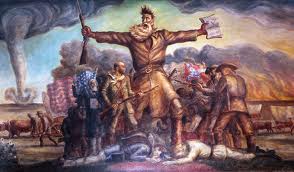
John Brown's Body

We've been on a bit of a John Brown tour during our holidays, visiting Charles Town WV (then Charlestown VA, where he was tried and hanged - we saw the courthouse, still in use) and Harpers Ferry, where he tried to seize a federal arsenal to arm slaves in 1859. Today we visited his farm, and the graves of John Brown and his sons, near Lake Placid NY - Brown settled there to be near a colony of freed slaves and free African Americans, although the settlement eventually folded due to the poor farming conditions and harsh weather of New York's North Country. Today the ski jump towers from the 1980 Winter Olympics overlook the simple house and barn of Brown's family.

So we have seen the last resting place of 'John Brown's Body' - lying underneath the gravestone that was originally his father's, a veteran of the American Revolution.

Had I interfered in the manner which I admit, and which I admit has been fairly proved (for I admire the truthfulness and candor of the greater portion of the witnesses who have testified in this case), had I so interfered in behalf of the rich, the powerful, the intelligent, the so-called great, or in behalf of any of their friends, either father, mother, brother, sister, wife, or children, or any of that class, and suffered and sacrificed what I have in this interference, it would have been all right; and every man in this court would have deemed it an act worthy of reward rather than punishment.
This court acknowledges, as I suppose, the validity of the law of God. I see a book kissed here which I suppose to be the Bible, or at least the New Testament. That teaches me that all things whatsoever I would that men should do to me, I should do even so to them. It teaches me, further, to "remember them that are in bonds, as bound with them." I endeavored to act up to that instruction. I say, I am yet too young to understand that God is any respecter of persons. I believe that to have interfered as I have done as I have always freely admitted I have done in behalf of His despised poor, was not wrong, but right. Now, if it is deemed necessary that I should forfeit my life for the furtherance of the ends of justice, and mingle my blood further with the blood of my children and with the blood of millions in this slave country whose rights are disregarded by wicked, cruel, and unjust enactments, I submit; so let it be done!
- John Brown's last speech in court, November 2, 1859

Saturday, July 23, 2011

What Are We Going to Say About Labels, Supermodels, Seeds, and Pearls?: Sermon, July 24, 2011

Genesis 29:15-28
Romans 8:26-39
Matthew 13:31-33, 44-52

Giving all glory and honour to God.

So what are we going to say about these things? That’s the Apostle Paul, in his letter to the Roman church that is one of our readings today, but he could be talking about our three selections from the Bible. What are we going to say?

Paul continues, if God is for us, who is against us? Who will condemn us? In Paul’s letter these words are meant to be reassuring, comforting, because he answers these questions. But in our lives, when we ask, who is against us, who will condemn us, we don’t always get these calming, soothing responses. Sometimes we know who it is who is against us, and we can name them, or we know that it’s a whole society. And we feel condemned.

In our first reading, we’re continuing last week’s story of Jacob, on the run from his brother. Jacob finds his uncle, Laban, and falls in love with his cousin Rachel, and works for Laban seven years so he can marry her. But Jacob, who is on the run in the first place because he fooled his father into giving him his brother’s inheritance, is fooled himself – tricked by Laban into marrying Rachel’s older sister Leah. And he works another seven years so he can marry Rachel too. Men could have more than one wife back then.

The writer of this book of the Bible states that Rachel was graceful and beautiful. Rachel is the hot one Jacob and all the other guys fall for when they see her. Leah is pawned off by her father because she isn’t pretty; the writer says that she has lovely eyes – which sounds like the words of someone trying to be kind. The only way for her to get a husband is to trick a man into marriage. Jacob marries her because he has to, but the story makes it plain that he doesn’t love her.

Who is against Leah? Who will condemn her? The people around her who judged her by the beauty standards of her society, in a story that is set nearly 40 centuries in the past, and things haven’t changed much since then. Magazines and movies and TV shows and websites still favour the Rachels over the Leahs. And we want to be Rachels, because who wants to be a Leah, unloved and unwanted? So we go beyond just using makeup and hair styling, and turn to cosmetic surgery and even extreme dieting or steroids as we try to look like supermodels and beauty queens and muscle men. There is an epidemic of unhealthy weight loss and anorexia among teenage girls because society gives them the message that they will be unattractive unless they are thin.

I’m interested in this as I have a disability. When our society looks at disability, it focuses on what one can’t do; the idea is that the body or mind aren’t working properly. This thinking leads to labels being given to people with disabilities, descriptions like cripple, handicapped, retarded. And these labels convey with them the idea that people with disabilities are worth less than able-bodied people. It’s only a short step from saying that people with disabilities have a problem, to saying that they are a problem. Advocates for people with disabilities call this thinking ableism, a set of stereotypes like racism and sexism.

And I need to add ageism here, as beauty in our culture means youth. Just as people with disabilities are given the message that they are worth less and are a problem, society gives the same idea to seniors, that the hair and skin and ability and health of elderly people are less than ideal.

It’s hard to be labeled crip, loser, geek, ugly. We may hope that these labels stop after high school, but they last as we go through life, particularly in this Internet age when anonymous people comment viciously on anything they find online. We may be saddled with the names and insults heaped onto anyone who has a disability or whose face or hair or body type or clothing, or speech or mannerisms or sexuality, isn’t what our culture considers fashionable and good-looking and normal.

Our world judges by superficial standards just as much as, and probably more than, the world of Leah, Rachel and Jacob. Our culture may pay lip service to everyone being equal no matter what they look like, but it tends to put down authenticity and and degrade anyone who doesn’t look like the ideal. The singer Pink has a song on the radio, called Perfect, and sings about how her critics don’t like her jeans and don’t get her hair, yet she does it too to other people, all the time. We know how we make snap judgments based on appearance.

Yet, in fact, sisters and brothers, we are all Leahs. It is impossible for us to meet the criteria of our fashion and beauty-obsessed culture 100 percent of the time. We can’t all be celebrities, and they can’t measure up to their media images continually either. The perfect people we are compared to, forever young, athletic, beautiful, sexualized, exist only in the imaginations of the media and advertisers. All of us - no matter how young or old we are or what we look like - all of us know at some point in our lives, maybe most of our lives, what it is like to be labeled, criticized, degraded, unwanted, to feel that we are worth less.

Paul writes to another church, the one in Corinth, and tells them, brothers and sisters, by ordinary human standards not many of you were wise, not many were powerful, not many were from the upper class. He could have said, not many of you were Rachels. Most of you, maybe all of you, were Leahs. And Paul continues, but God chose what the world considers foolish to shame the wise. God chose what the world considers weak to shame the strong. God chose what the world considers unattractive to shame the beautiful. God chose what the world considers to be nothing to reduce what is considered to be something, to nothing.

Into this world of superficiality and unachievable standards comes Jesus with his good news. In five little stories this morning he talks about the realm of God, where God’s love and justice and peace break into our world of shallowness and selfishness. Yet God’s realm is like something that is considered like nothing, worthless: a mustard seed. Yeast. So common in the time of Jesus they weren’t worth thinking about. Or so the society of the time, and our society today, would think. But God chooses what seems insignificant, and ordinary, to shame what the world considers famous and beautiful.

Jesus talks about the mustard seed, thought in his time to be the tiniest of seeds. Yet from that miniscule seed come mustard plants that become shrubs eight to ten feet tall. The contrast would have been obvious to his listeners. Tiny seed, huge plant.

Jesus is saying that the greatest things have the least auspicious beginnings. What is ordinary, looked down upon, dismissed by society, brings God’s realm.
A little seed becomes a tree. A few grains of yeast cause a whole loaf of bread to rise. God comes in human form as a crying baby, Jesus, born in an unimportant place in a backwater of the Roman Empire. Jesus, who always identified with anyone suffering and shut out by society, is telling us that small things count, as we sang in our hymn; small things count as big things in God’s mind.

God does not judge as we and the world judge. God has different ways to measure beauty. God sees potential where we write off ugliness and disability and old age. Jesus says that the kingdom of heaven is like a merchant in search of fine pearls. When he found one very precious pearl, one pearl of great price, he went and sold all that he owned and bought it.

Brothers and sisters, God sees each one of us as unique treasures. To God we are pearls, pearls of great price. It doesn’t matter to God what we look like, whether we are graceful like Rachel or the best anyone can say of us is that we have lovely eyes like Leah. It doesn’t matter to God what labels people attach to us. We are pearls, and God will search for us, and find us, and sell everything to buy us. And God has done that, as Paul tells the Romans: God gave up Jesus, God’s Son, for us all. Pink sings in her song, if you ever, ever feel like you’re nothing, you are perfect to me, and that could be what God is whispering to us.

If God is for us, who is against us? Who will condemn us? Well, lots of people may try condemning us for our looks or our ability or our background or our beliefs. But Jesus helps us discover our value as unique creations of God. When we feel beaten down by criticism, when we feel small, then we can remember that small things count. We count in God’s mind. We may feel as Paul describes, quoting Scripture, as if we are being put to death all day long, treated like animals for slaughter. Yet Paul continues to tell the Roman church, and us: But in all these things we win a sweeping victory through the one who loved us. I’m convinced that neither death nor life, nor angels nor rulers, nor present things nor future things, nor powers nor height nor depth, nor any other thing that is created, can separate us from God’s love in Christ Jesus our Lord. This is the good news. Thanks be to God.

Tuesday, July 19, 2011

Church for the 21st century: Family structures

Carol Howard Merritt has a great, and challenging, post about family structures in the 21st century church. Looking at her questions, I admit that my congregations are falling short - most of our singles are elderly widows and widowers, and we don't have many younger singles and families (and we still won't have many unless we become more hospitable). I am trying to place a priority on broadening our programming for children, teens, and young families. The Ingleside church building is full of young parents and children when we have special family events at Christmas and Easter.

Carol asks, 'If a young couple is living together (this is often a financial necessity), do our churches welcome them?' This reminds me of a conversation we had at one of the local ministerial meetings, which brings together clergy from various denominations. We were discussing preparation for marriage, and one of the evangelical pastors stated that when he finds out that a couple is living together, he tells them that they must live separately until their wedding or he will refuse to marry them. I responded that if I didn't marry people who are living together, we would have no weddings at all. When I look at our marriage registers, the bride and groom's addresses are the same in nearly every case. And if some Christians see living together as a sin, wouldn't they want the wedding to go ahead so this state of wrongdoing can cease?